
Ectopic Pregnancy Treatment in Thane
Ectopic Pregnancy: Symptoms, Diagnosis & Treatment
Ectopic pregnancy requires timely assessment because delayed diagnosis can lead to rupture and internal bleeding. Dr. Nikita Kulkarni, Consultant Obstetrician and Gynaecologist, provides ectopic pregnancy treatment in Thane based on the woman’s symptoms, ultrasound findings, and overall clinical condition.
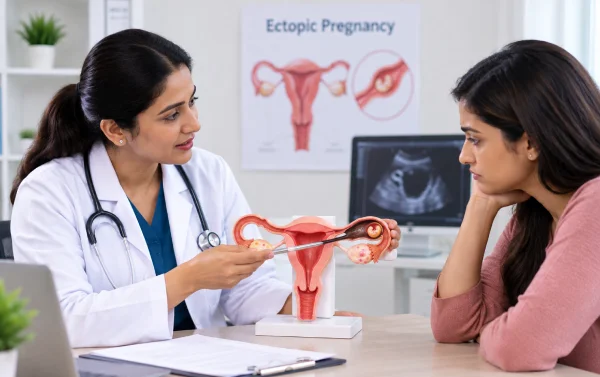
What Is an Ectopic Pregnancy?
An ectopic pregnancy occurs when a pregnancy implants outside the endometrial cavity, most commonly within a fallopian tube. Because an ectopic pregnancy cannot develop normally and may rupture, causing serious internal bleeding, timely diagnosis and appropriate management are important.
Where Can an Ectopic Pregnancy Occur?
Most ectopic pregnancies occur in the fallopian tube. Tubal ectopic pregnancies may occur in the ampullary, isthmic, fimbrial or interstitial portion of the tube. Less commonly, ectopic pregnancy can occur in the cervix, ovary, Caesarean scar or abdominal cavity.
Why Does an Ectopic Pregnancy Occur?
An ectopic pregnancy occurs when a fertilised egg implants outside the uterine cavity. In many women, no single cause can be identified. Conditions that damage or alter the fallopian tubes can increase the likelihood of ectopic implantation.
Risk Factors for Ectopic Pregnancy
Several factors are associated with an increased risk of ectopic pregnancy, although it can also occur in women without identifiable risk factors. These include:
- Prior Ectopic Pregnancy – Prior ectopic pregnancy increases the risk of recurrence.
- Smoking – Recent smoking around the time of conception could increase the risk.
- Pelvic inflammatory disease (PID) – Previous PID, including infections of the uterus, fallopian tubes or ovaries caused by sexually transmitted infections such as chlamydia or gonorrhoea, can increase the risk of ectopic pregnancy.
- Increasing maternal age – The risk of ectopic pregnancy increases with maternal age.
- Previous tubal surgery – May increase the risk of ectopic pregnancy.
- Previous sterilisation – Pregnancy after sterilisation has a higher likelihood of being ectopic.
- Assisted reproduction such as IVF/ICSI – May be associated with an increased risk in selected situations.
- Pregnancy occurring with an IUD in situ – Although uncommon, pregnancies occurring with an IUD are more likely to be ectopic.
Signs and Symptoms of Ectopic Pregnancy
Ectopic pregnancy might lead to symptoms resembling those of normal pregnancy, but there may also be certain indications that can develop as the problem progresses.
- Pain – Lower abdominal or pelvic pain, often on one side, may occur.
Bleeding – Vaginal bleeding or spotting may happen. - Additional symptoms – Dizziness, weakness or fainting may result from blood loss (particularly with significant internal bleeding), especially if the fallopian tubes rupture. Some women experience gastrointestinal symptoms or rectal pressure.
- Some ectopic pregnancies initially cause few or no symptoms.
When Is an Ectopic Pregnancy a Medical Emergency?
A ruptured ectopic pregnancy is a medical emergency that requires immediate assessment and treatment at a hospital. Seek urgent medical attention if you experience:
- Severe, sudden or worsening abdominal or pelvic pain
- Vaginal bleeding
- Dizziness, weakness, or fainting
- Shoulder-tip pain, which may indicate internal bleeding
How Is an Ectopic Pregnancy Diagnosed?
Diagnosis is based on clinical assessment together with pregnancy testing, transvaginal ultrasound and, when required, serial serum β-hCG measurements. This can be evaluated by:
- Clinical evaluation – Helps to assess the medical history, symptoms, and clinical findings.
- Transvaginal ultrasound – Helps to determine the location of the pregnancy. In very early pregnancy, the pregnancy may not be visible on ultrasound, and a repeat scan may be required.
- Serial serum β-hCG – Helps to measure pregnancy hormone levels over time when required. Repeat blood tests may be needed to help clarify the diagnosis.
- Follow-up assessment – If the pregnancy test is positive but no pregnancy is visible on ultrasound, it is considered a pregnancy of unknown location. This may represent a very early intrauterine pregnancy, a miscarriage, or an ectopic pregnancy and requires appropriate follow-up.
Treatment Options for Ectopic Pregnancy
Doctors choose treatment based on the patient’s condition, pregnancy findings, and clinical assessment. Treatment options include:
- Expectant management – May be suitable for carefully selected, clinically stable women with few or no symptoms and appropriate ultrasound and β-hCG findings, provided reliable follow-up is possible.
- Medical management with methotrexate – Methotrexate may be offered to selected clinically stable women when specific eligibility criteria are met. Follow-up with serial β-hCG testing is essential, and some women may still require additional treatment or surgery.
- Surgical management – Surgery may be required depending on symptoms, clinical stability, ultrasound findings, β-hCG levels and suitability for non-surgical treatment.
When Is Surgery Required for an Ectopic Pregnancy?
Surgery may be recommended when:
- There is suspected or confirmed rupture or significant internal bleeding
- The woman is hemodynamically unstable or has significant symptoms
- Methotrexate is contraindicated or unsuitable
- Medical or expectant management has failed
- Ultrasound findings, β-hCG level, ectopic size or fetal cardiac activity make non-surgical management less appropriate
- Surgery is otherwise considered the safest treatment based on the clinical situation.
Laparoscopic Surgery for Ectopic Pregnancy
When surgery is required, laparoscopy is commonly used in clinically stable women. Depending on the condition of the affected tube, the opposite tube, fertility considerations and the clinical situation, surgery may involve removal of the affected fallopian tube (salpingectomy) or removal of the ectopic pregnancy while preserving the tube (salpingotomy) in selected cases.
Recovery After Ectopic Pregnancy Treatment
- Attend your follow-up visits for your progress on recovery and treatment.
- Ensure you get adequate rest and avoid strenuous exercise or activities that may strain your body.
- Use any medications as prescribed by your doctor.
- Emotional recovery can take longer than physical recovery. Feelings of grief, anxiety or fear regarding future pregnancies are common, and counselling or psychological support may be helpful when needed.
- Women managed expectantly or with methotrexate require serial β-hCG monitoring until the pregnancy has resolved. Follow-up may also be required after salpingotomy.
Can You Get Pregnant After an Ectopic Pregnancy?
Yes. Many women can have a future intrauterine pregnancy after an ectopic pregnancy. Future fertility depends on factors such as the health of the fallopian tubes, the underlying cause of the ectopic pregnancy and the treatment required.
However, the risk of another ectopic pregnancy is higher after a previous ectopic pregnancy.
Timing future pregnancy:
- After methotrexate treatment, women are generally advised to avoid pregnancy for 3 months and should follow their treating doctor’s advice regarding contraception and future conception.
- For surgery/expectant management, timing can be individualised.
Pregnancy After a Previous Ectopic Pregnancy
Early assessment in a subsequent pregnancy can help confirm the location of the pregnancy.
- Consult your doctor as soon as you test positive for pregnancy.
- An early transvaginal ultrasound may be performed to confirm that the pregnancy is developing within the uterus.
- Serial β-hCG testing may be advised when clinically indicated to monitor pregnancy progression.
- Report severe pelvic pain, abnormal vaginal bleeding, dizziness, or fainting promptly.
Dr. Nikita Kulkarni’s Approach to Ectopic Pregnancy
– Clinical Assessment and Diagnosis
Symptoms, medical and obstetric history, examination findings, ultrasound and β-hCG results are assessed to establish the pregnancy location and clinical stability.
– Individualised Management
Expectant, medical or surgical management is considered according to the woman’s clinical condition, ultrasound findings, β-hCG levels, treatment eligibility, fertility considerations and preferences.
– Effective Communication
The process involves explaining the diagnosis, available treatment options, and recovery process in simple language.
– Follow-up and Future Pregnancy Planning
Appropriate follow-up is arranged according to the treatment, with counselling on warning signs, recovery, and monitoring in a future pregnancy.
Women with symptoms or concerns regarding ectopic pregnancy can consult Dr. Nikita Kulkarni, Consultant Obstetrician and Gynaecologist in Thane, for clinical assessment and individualised management.